Workshop Spray Foam Insulation in Murfreesboro, TN
Workshop spray foam insulation is about making a shop or workspace usable year-round—whether it's a detached woodworking shop, an automotive garage workshop, a metal shop, or a hobby space attached to the home. Murfreesboro Spray Foam Installation insulates workshop roof and wall assemblies across Murfreesboro and Middle Tennessee, sealing the perimeter so that heating or cooling the space is practical. We evaluate each workshop's construction, use, and ventilation before recommending a foam approach, and we do not suggest insulation as a substitute for proper ventilation where fumes, dust, or combustion are involved.
Tell Us About Your Project
Share your building type and the areas you want insulated. We respond with project guidance.
Insulating a Workshop for Year-Round Use
A workshop is defined less by its construction than by how it is used. The same building might be a woodworking shop, an automotive workspace, a metal fabrication shop, or a hobby outbuilding—and the insulation strategy should reflect that use. Spray foam seals the roof and wall perimeter so that a mini-split or forced-air system can actually hold a comfortable temperature without fighting constant air leakage.
Murfreesboro homeowners and tradespeople typically consider workshop spray foam when a shop becomes too hot or cold to use comfortably, when condensation forms on metal surfaces, or when a new shop is being built and the owner wants the envelope right from the start. The approach depends on the building type—metal, wood-framed, or post-frame—and how the space is used.
An important qualification: spray foam is not a substitute for proper ventilation. Where a workshop involves fumes, combustion equipment, dust, or chemicals, ventilation and air exchange must be handled appropriately and is considered alongside the insulation strategy. We do not suggest that insulation alone makes a workshop safe for those uses.
Yes. Spray foam seals a workshop's roof and wall perimeter so that heating or cooling the space is practical, and it helps manage condensation on metal surfaces. The right approach depends on the building type—metal, wood-framed, or post-frame—and how the space is used, with ventilation handled separately where fumes or dust are present.
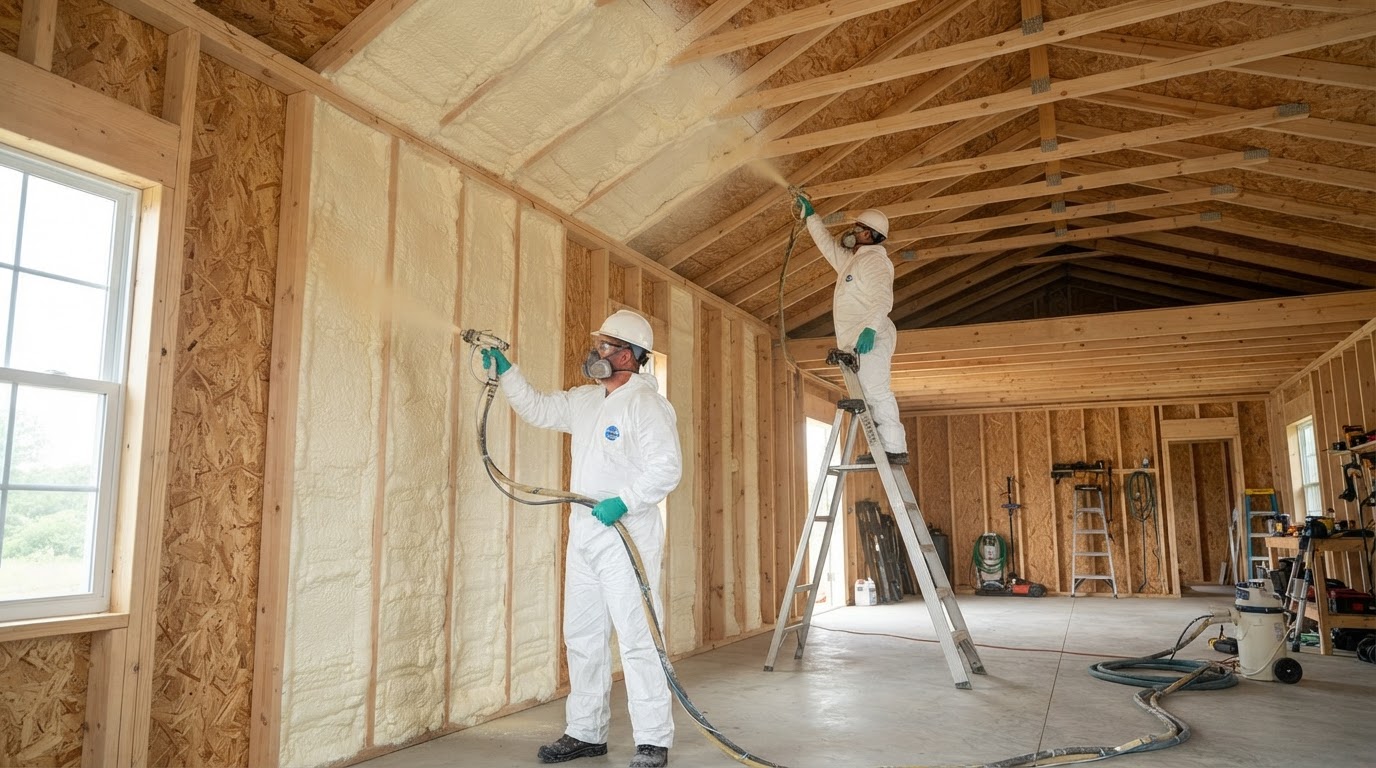
Sealing the perimeter makes conditioning a workshop practical.
Types of Workshops We Insulate Near Murfreesboro
Workshops vary widely in construction and use. These are the workshop types and considerations we evaluate across Murfreesboro and Rutherford County.
Detached Workshops
Standalone shop buildings—wood-framed or metal—are the most common workshop application, with foam on the roof and wall perimeter to support conditioning.
Attached Workspaces
Workshops attached to the home or garage are insulated to isolate the workspace from living areas while supporting climate control within the shop.
Metal Shops
Metal workshop buildings benefit from foam that adheres to steel panels and framing, addressing the condensation common to metal roof and wall surfaces.
Woodworking Shops
Woodworking spaces are evaluated with dust and ventilation in mind—insulation supports conditioning but does not replace needed air exchange.
Automotive Workshops
Automotive spaces involving fumes or combustion are insulated with ventilation handled separately, so the building operates safely alongside the envelope.
Roof & Wall Assemblies
Most workshops are insulated on both the roof and walls to create a continuous envelope, with garage doors treated as a separate assembly consideration.
Foam Selection and Ventilation Considerations
Workshop foam selection depends on the building type and use. Closed-cell is often chosen for metal shops because of its adhesion to steel and condensation management; open-cell may suit wood-framed shops where expansion and a vapor-open assembly fit. Whether the shop is conditioned, semi-conditioned, or only occasionally heated and cooled affects the scope.
The ventilation qualification is central. Spray foam supports conditioning a workshop by sealing the envelope, but where fumes, combustion equipment, dust, or chemicals are present, ventilation and air exchange must be designed appropriately. Insulation is not a substitute for that ventilation, and we raise it as part of the conversation for any workshop with those uses.
| Consideration | Open-Cell Foam | Closed-Cell Foam |
|---|---|---|
| Metal Shops | Vapor-open interior only | Common for metal roof & walls |
| Wood-Framed Shops | Expansion fills framing cavities | Denser layer, limited depth |
| Conditioning Goal | Semi-conditioned, vapor-open | Conditioned, condensation focus |
| Ventilation Role | Insulation supports conditioning | Insulation supports conditioning |
| Air Sealing | Seals roof & wall perimeter | Seals metal-to-framing junctions |
| Selection Driver | Building type, use, depth | Substrate, condensation, use |
General workshop considerations; selection and ventilation depend on the building type, use, and whether fumes or dust are present.
Insulation Is Not Ventilation
Spray foam helps condition a workshop by sealing the envelope, but it does not substitute for proper ventilation where fumes, combustion equipment, dust, or chemicals are present. Ventilation and air exchange must be designed appropriately and are considered alongside any insulation strategy.
Planning a Workshop Spray Foam Project in Murfreesboro
Workshops are a high-priority application across Murfreesboro and Rutherford County, where homeowners, tradespeople, and hobbyists build or upgrade shop space for year-round use. Middle Tennessee's climate makes both summer heat and winter chill a factor, so a sealed envelope is what makes a mini-split or heater practical in the first place.
A workshop project starts with understanding the building type, how it is used, and whether ventilation is a concern. We review the construction—metal or wood-framed, roof and wall access—and the conditioning goal, then recommend a foam approach that fits the workshop's actual use.
Discuss the workshop type—detached, attached, metal, or wood-framed—and how it is used.
Review the roof and wall assemblies, substrate, and any condensation on metal surfaces.
Note ventilation needs for fumes, dust, or combustion and how they fit the insulation plan.
Recommend a foam approach for the roof and walls and complete the application.
Workshop Spray Foam FAQs
Yes. Metal workshops are a common application, with closed-cell foam typically chosen for its adhesion to steel and condensation management on metal roof and wall surfaces. The building's use and substrate are evaluated before a recommendation is made.
Want to Make Your Murfreesboro Workshop Usable Year-Round?
Tell us about your workshop—its construction, how you use it, and whether ventilation is a concern. We review the building and outline an appropriate workshop spray foam approach.