
Pole Barn Spray Foam Insulation in Murfreesboro, TN
Pole barn and post-frame buildings are a familiar sight across Murfreesboro and Rutherford County—equipment storage, agricultural buildings, hobby barns, and utility structures. Spray foam is a strong fit for these buildings because it seals the irregular gaps between timber posts, girts, and corrugated metal that conventional insulation leaves open. Murfreesboro Spray Foam Installation evaluates each post-frame structure's framing, substrate, and intended use before recommending a roof, wall, or full-envelope spray foam approach.
Tell Us About Your Project
Share your building type and the areas you want insulated. We respond with project guidance.
Spray Foam for Pole Barns and Post-Frame Buildings
Post-frame construction uses embedded timber posts rather than a continuous foundation wall, with girts and purlins supporting metal or wood cladding. That framing is irregular by nature—gaps between posts and cladding, varying girt spacing, and the junctions where metal meets wood. Spray foam expands to seal those irregular gaps in one continuous layer, which is why it is so often chosen over batts for these buildings.
Owners of Murfreesboro pole barns typically consider spray foam when they want to condition or semi-condition the space, address condensation on a metal roof, or make a drafty storage building usable in hot or cold weather. The approach depends on the framing, the cladding material, and how the building will be used—storage, workshop, livestock-adjacent, or finished space.
Because post-frame buildings vary so much, the intended use matters. A fully finished barndominium calls for a different scope than a basic equipment-storage barn. We evaluate the structure and the use before recommending where foam goes and which type fits.
Yes. Spray foam is well suited to pole barns and post-frame buildings because it expands to seal the irregular gaps between timber posts, girts, and corrugated metal cladding that batts leave open. Roof, wall, or full-envelope applications are evaluated based on the building's framing and intended use.
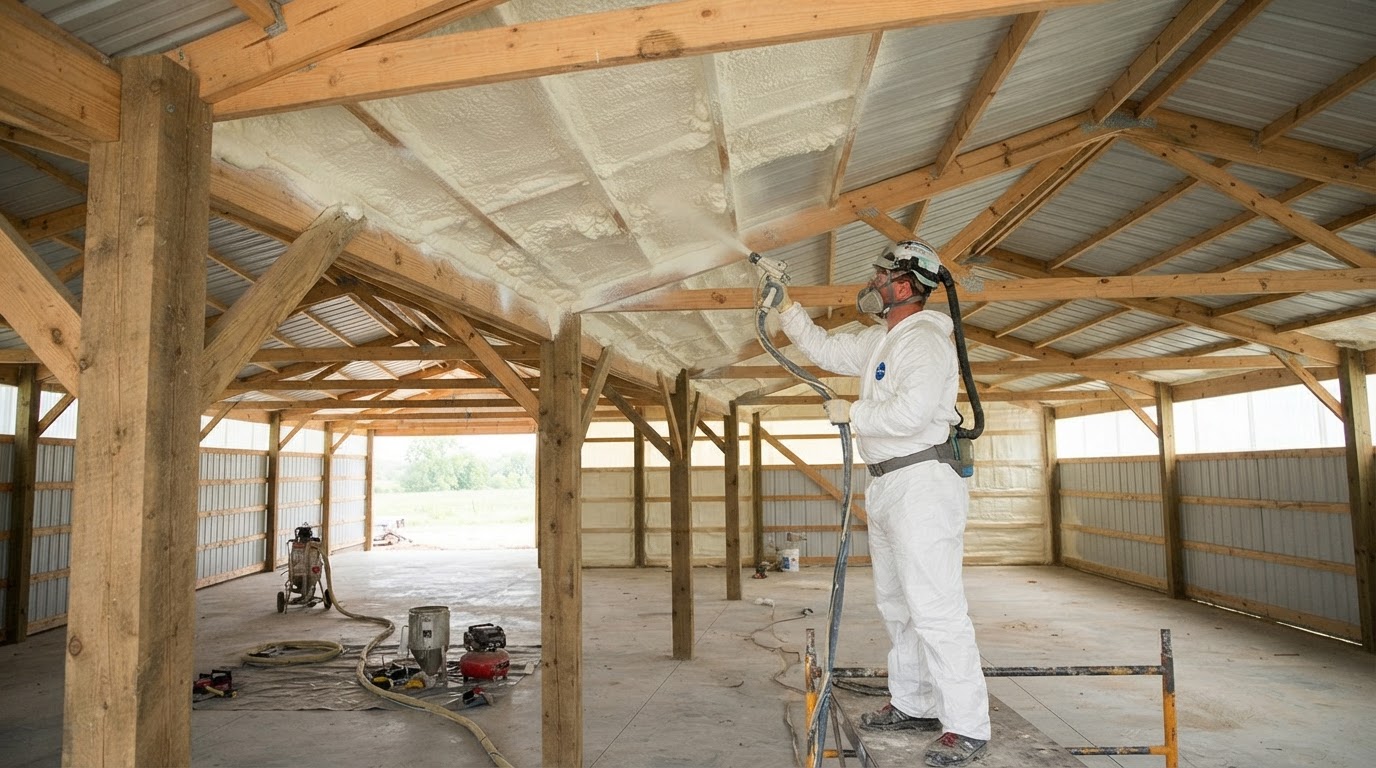
Foam conforms around timber posts and metal cladding in one continuous layer.
Pole Barn Applications in Rutherford County
Post-frame buildings serve many purposes across the region. These are the pole barn types and areas where spray foam is commonly considered.
Equipment Storage Barns
Storage buildings benefit from foam that seals drafts and helps moderate interior conditions, protecting equipment from temperature and humidity swings.
Agricultural-Use Buildings
Agricultural post-frame buildings are evaluated for foam based on substrate, ventilation, and use—qualified language is used where livestock are involved.
Hobby & Workshop Barns
Pole barns used as hobby or workshop spaces are common candidates, especially when the owner plans to heat or cool the interior.
Post-Frame Roofs
Applying foam to the underside of a pole-barn roof addresses the metal-to-air interface where condensation often forms.
Post-Frame Walls
Wall foam seals around girts and cladding, reducing air leakage across the building perimeter.
Future Finish Planning
Whether the interior will later be finished affects foam scope and type—planning ahead avoids rework when walls or ceilings are enclosed.
Foam Type and Building-Use Considerations
Foam selection for a pole barn depends on the substrate and the building's use. Closed-cell is often considered for metal-clad post-frame roofs and walls because of its adhesion to steel and moisture tolerance. Open-cell may fit interior framed sections where expansion is helpful and the assembly is vapor-open. The intended use drives the decision as much as the substrate.
A building meant for basic equipment storage may need a different scope than one intended as a conditioned workshop or a future finished residence. Ventilation and use also matter—especially where dust, fumes, or livestock are involved, the building's operation must be considered alongside the insulation strategy.
| Consideration | Open-Cell Foam | Closed-Cell Foam |
|---|---|---|
| Roof / Metal Cladding | Vapor-open assembly only | Common for metal roof & wall cladding |
| Wall Framing | Interior framed sections, expansion | Seals around girts, moisture tolerance |
| Use Consideration | Vapor-open, semi-conditioned | Conditioned or moisture-sensitive use |
| Adhesion | Wood framing, interior | Metal cladding and wood substrates |
| Air Sealing | Seals framing gaps | Seals metal-to-wood junctions |
| Selection Driver | Use, depth, interior finish | Substrate, moisture, conditioning |
General pole-barn considerations; selection depends on the substrate, building use, and whether the interior will be finished.
Building Use Affects Foam Selection
Whether a pole barn is used for storage, a workshop, or a future finished space affects the foam scope and type. We consider the intended use, ventilation, and any dust, fumes, or livestock factors alongside the substrate before recommending an approach.
Pole Barn Projects Across Middle Tennessee
Pole barns and post-frame buildings are common on Murfreesboro-area acreage and across Rutherford County, used for everything from equipment storage to hobby workshops to the shell of a future barndominium. Middle Tennessee's climate puts condensation and temperature swings at the top of the list for metal-clad post-frame roofs.
A pole barn project starts with understanding the building's framing, cladding, and intended use. We review the substrate, note any condensation on the roof, and consider whether the interior will be finished—then recommend a roof, wall, or full-envelope approach that fits how the building will actually be used.
Discuss the pole barn's construction, cladding, and how it will be used.
Review the framing, substrate, and any visible condensation on metal surfaces.
Consider whether the interior will be finished later, which affects scope and type.
Recommend a roof, wall, or full-envelope foam approach and apply it.
Pole Barn Spray Foam FAQs
Yes. Applying foam to the underside of a pole-barn roof is common, especially on metal-clad roofs where condensation forms. The foam seals the metal-to-air interface and helps manage condensation, though outcomes depend on the full assembly and interior humidity.
Planning to Insulate a Pole Barn in Murfreesboro?
Tell us about your post-frame building—its construction, cladding, and how it will be used. We review the framing and substrate and outline an appropriate pole barn spray foam approach.