Metal Building Spray Foam Insulation in Murfreesboro, TN
Metal building spray foam insulation is built around the specific behavior of steel structures—corrugated panels, purlins, girts, and the condensation that forms when humid interior air meets cold metal. Murfreesboro Spray Foam Installation applies spray polyurethane foam directly to the interior of steel and metal buildings across Murfreesboro and Middle Tennessee, creating a continuous thermal and air layer across roof and wall assemblies. We evaluate each metal building's substrate, use, and condensation conditions before recommending a foam approach.
Tell Us About Your Project
Share your building type and the areas you want insulated. We respond with project guidance.
Why Spray Foam Fits Metal Buildings
Metal buildings present challenges that conventional insulation handles poorly. Corrugated panels, purlins, and girts create irregular surfaces and gaps that batts and rigid board struggle to seal. Spray foam expands to adhere directly to those steel surfaces, following the corrugations and filling the spaces between framing members in one continuous layer.
Owners of Murfreesboro metal buildings typically consider spray foam to address condensation on the interior of the roof or walls, temperature swings that make the building unusable in summer or winter, or a plan to condition a previously unconditioned shop or storage space. The approach depends on the substrate, whether the building is new or existing, and how the space will be used.
A key qualification: spray foam helps manage condensation by isolating interior air from cold metal, but it does not universally stop all condensation in every condition. Substrate temperature, interior humidity, and assembly design all affect the outcome and are evaluated per building.
Spray foam is considered for metal buildings because it adheres directly to corrugated steel panels, purlins, and girts, filling the irregular gaps that batts and rigid board leave open. It creates a continuous thermal and air layer that helps manage condensation and temperature swings common to steel structures.
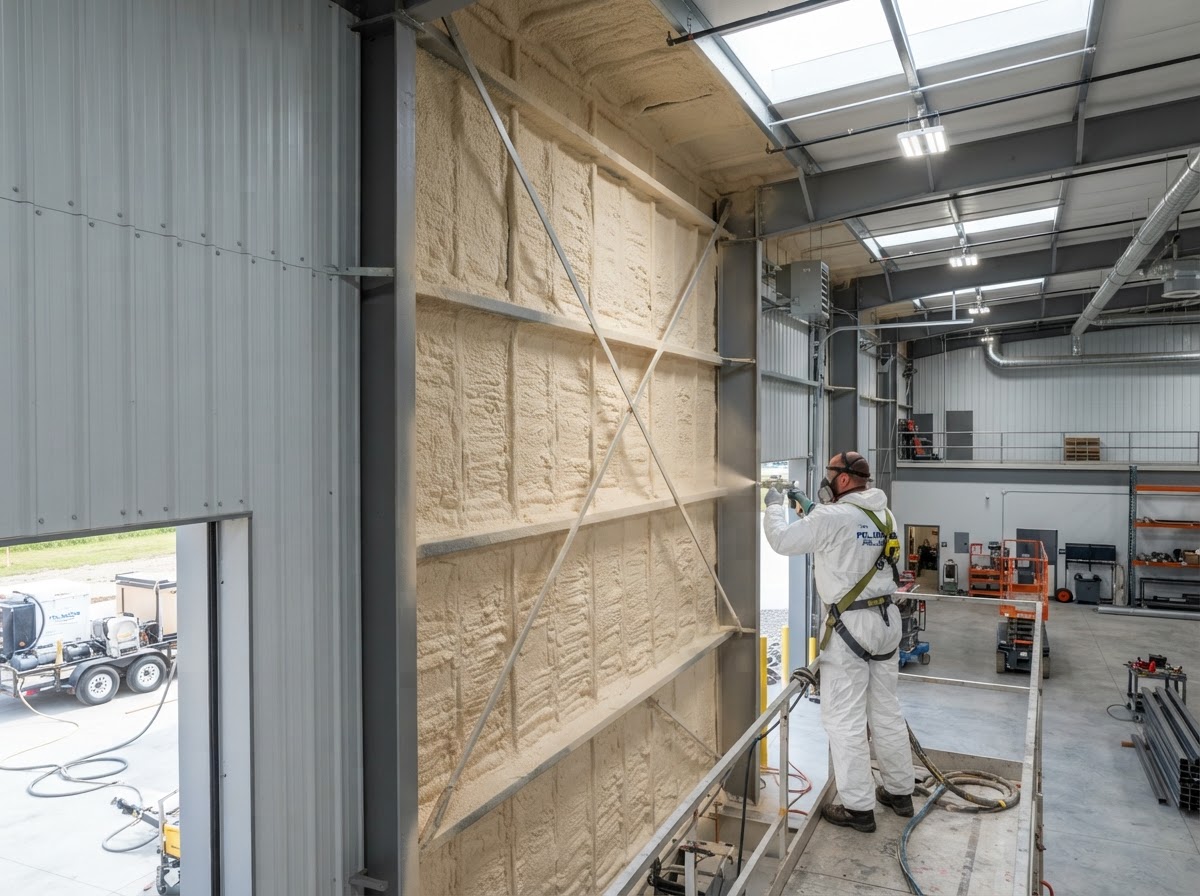
Foam adhering directly to corrugated steel isolates interior air from cold metal.
Metal Building Applications Across Murfreesboro
Metal structures range from agricultural storage to commercial facilities. These are the applications and building types where spray foam is commonly considered in the region.
Pre-Engineered Steel Buildings
New or existing steel buildings benefit from foam that adheres directly to panels and framing, sealing the gaps that batts leave across purlins and girts.
Metal Roofs & Roof Decks
Applying foam to the underside of a metal roof addresses the surface where condensation most often forms, as part of a condensation strategy.
Metal Wall Assemblies
Interior wall foam seals around girts and panels, reducing air leakage and supporting a more controlled interior environment.
Shops & Storage Buildings
Metal shop and storage structures are common candidates, especially when the owner plans to condition or semi-condition the space.
Agricultural Steel Structures
Steel agricultural buildings used for equipment, storage, or livestock-adjacent purposes are evaluated for foam based on use and substrate.
Commercial Metal Facilities
Larger commercial metal buildings—warehouses, light industrial—use foam on roof and wall assemblies to support environmental control.
Foam Selection and Condensation Strategy
Closed-cell foam is frequently the choice for metal buildings because of its moisture tolerance at specified thicknesses and its direct adhesion to steel. Open-cell, being vapor-open, is generally not the first choice where condensation on metal is the concern, though it may suit interior partitioning in some assemblies. The decision depends on the substrate, the building's use, and the condensation conditions.
The condensation strategy is the central consideration. Spray foam helps by isolating humid interior air from cold metal, but the outcome depends on interior humidity, ventilation, and the full assembly. We evaluate the building's conditions before recommending a foam approach and do not claim that foam universally stops all condensation.
| Consideration | Open-Cell Foam | Closed-Cell Foam |
|---|---|---|
| Common Choice | Generally not first choice for metal surfaces | Commonly chosen for metal roofs & walls |
| Substrate Adhesion | Adheres to prepared framing | Adheres directly to corrugated steel |
| Moisture Behavior | Vapor-open, not moisture-resistant | Moisture-tolerant at specified thickness |
| Condensation Role | Limited condensation management | Helps isolate interior air from cold metal |
| Air Sealing | Seals interior framing gaps | Seals across panels, purlins, and girts |
| Selection Driver | Interior partitioning, depth | Substrate, condensation, building use |
General metal-building considerations; selection and condensation strategy depend on the evaluated substrate, building use, and humidity conditions.
Spray Foam and Condensation
Spray foam can help manage condensation on metal by isolating interior air from cold surfaces, but it does not universally stop all condensation. Interior humidity, ventilation, substrate temperature, and assembly design all affect the outcome and are evaluated per building before a recommendation is made.
Planning a Metal Building Spray Foam Project
Metal buildings are common across Murfreesboro and Rutherford County—agricultural storage, workshops, commercial facilities, and residential-adjacent steel structures. Middle Tennessee's humidity makes the metal-to-air interface a real concern, so substrate condition and interior humidity are part of every evaluation.
A metal building project starts with understanding the building type, its use, and whether it is new or existing. We review the substrate—panels, purlins, and girts—and the condensation conditions, then recommend a foam approach that fits how the building will actually be used.
Discuss the metal building type, use, and whether it is new construction or an existing structure.
Review the substrate—corrugated panels, purlins, girts—and note any visible condensation or corrosion.
Determine an appropriate foam approach and condensation strategy based on the building's use.
Apply the foam to roof and wall assemblies and review the finished coverage.
Related Spray Foam Services
Metal Building Spray Foam FAQs
Yes. Closed-cell spray foam adheres directly to corrugated steel panels, purlins, and girts, which is one of the main reasons it is chosen for metal buildings. Proper substrate preparation and condition are reviewed before application.
Planning to Insulate a Metal Building in Murfreesboro?
Tell us about your steel or metal structure—its use, whether it is new or existing, and any condensation concerns. We review the substrate and outline an appropriate metal building spray foam approach.