Commercial Spray Foam Insulation in Murfreesboro, TN
Murfreesboro Spray Foam Installation provides commercial spray polyurethane foam insulation for businesses, builders, and facility managers across Murfreesboro and Rutherford County. We insulate offices, warehouses, retail buildings, light industrial spaces, storage facilities, and commercial metal structures. Spray foam creates a continuous thermal and air barrier across large roof decks, exterior framing, and metal assemblies, helping commercial property owners manage indoor environmental control and condensation across the building envelope.
Tell Us About Your Project
Share your building type and the areas you want insulated. We respond with project guidance.
Spray Foam for Commercial Facilities in Murfreesboro
Commercial spray foam is the same polyurethane technology used in residential work, but applied to the larger, more varied assemblies found in commercial construction. On a commercial roof deck, a long run of exterior framing, or the interior of a metal building, spray foam expands to form a continuous layer that follows the contours of steel purlins, girts, and framing without the seams and gaps left by rigid board or batt insulation.
Commercial property owners and project managers typically approach spray foam with goals around consistent indoor conditions, condensation control on metal surfaces, and a building envelope that performs as designed. The considerations differ from residential work—commercial buildings have larger spans, different mechanical loads, and stricter coordination with other trades on an active job site.
Because commercial structures vary widely, the building assembly drives the approach. A pre-engineered metal building, a masonry retail shell, and a wood-framed office suite each call for different evaluation before any foam is selected.
Spray foam can be used in many commercial building types, including offices, warehouses, retail spaces, light industrial facilities, storage buildings, and commercial metal structures. Suitability depends on the building assembly, substrate, and whether the space is occupied or being built out.
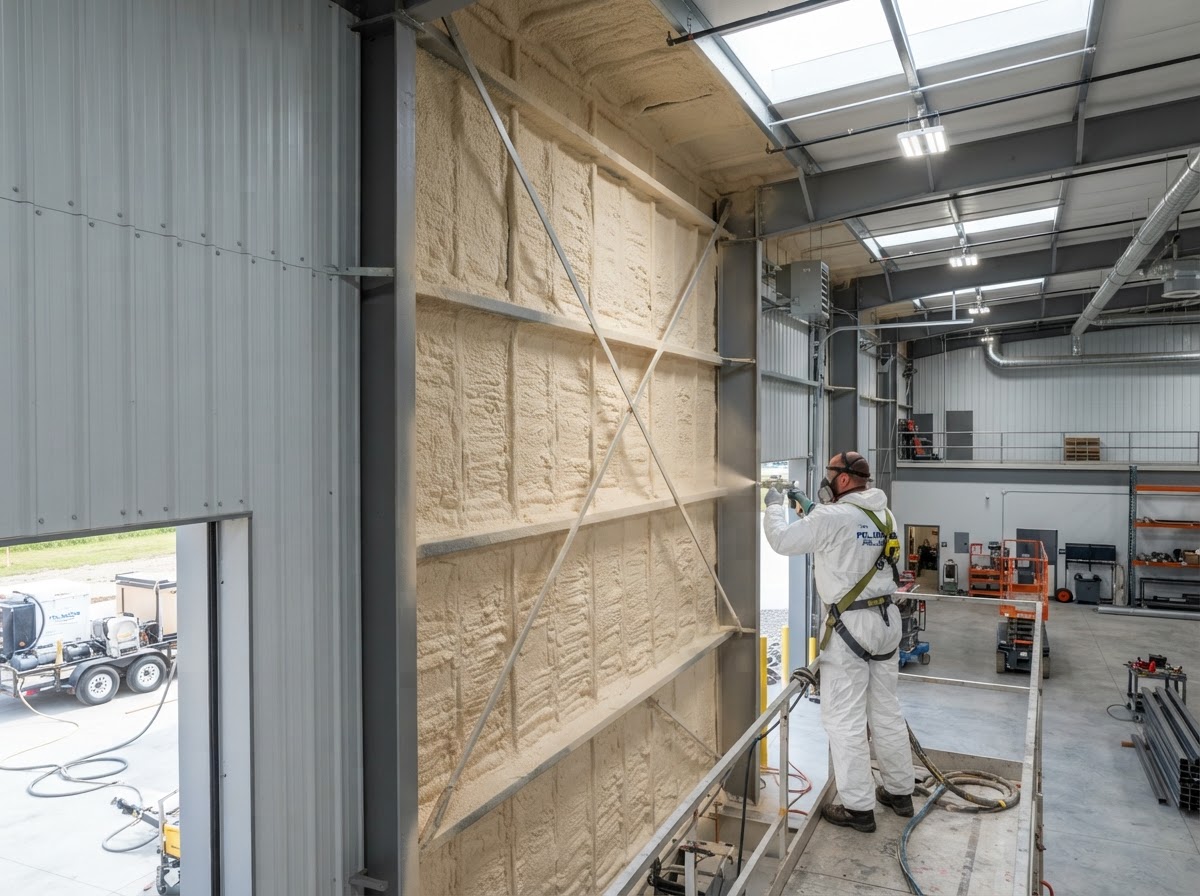
Continuous foam along steel framing creates an unbroken thermal layer across large commercial spans.
Commercial Applications Across Rutherford County
Commercial projects range from new construction to retrofits of occupied space. These are the commercial building types and areas where spray foam is commonly considered.
Office Buildings
Exterior wall cavities and roof decks in office build-outs benefit from continuous air sealing that supports consistent HVAC performance across leased suites.
Warehouses & Storage
Large roof decks and tall wall assemblies can be insulated in a continuous application, addressing the long spans and metal surfaces common to warehouse construction.
Retail Buildings
Perimeter walls and rooflines in retail shells help moderate interior conditions and limit air leakage around the varied penetrations found in storefront construction.
Commercial Metal Buildings
Pre-engineered steel buildings are a natural fit for spray foam, which adheres directly to corrugated panels and purlins to help manage condensation on metal surfaces.
Light Industrial & Shops
Production and shop spaces with large temperature differentials use foam on roof and wall assemblies to support a more controlled interior environment.
Tenant Build-Outs
During interior build-out of a leased commercial space, spray foam can establish the perimeter envelope before finishes are installed.
Foam Selection for Commercial Assemblies
Commercial foam selection is driven by the assembly more than by a single product preference. A metal roof deck, a masonry perimeter wall, and a framed office partition each behave differently, and the choice between open-cell and closed-cell depends on substrate, moisture exposure, cavity geometry, and the project's performance goals.
Closed-cell foam is frequently considered for commercial metal buildings, roof decks, and areas where a dense, moisture-resistant layer is wanted. Open-cell may be appropriate for interior partitioning or deeper framed assemblies where expansion is helpful. The correct approach is determined per assembly, not assumed across an entire building.
| Consideration | Open-Cell Foam | Closed-Cell Foam |
|---|---|---|
| Typical Use | Interior partitions, deep framing | Metal buildings, roof decks, masonry |
| Substrate Adhesion | Adheres to wood and prepared framing | Adheres to metal, masonry, and framing |
| Moisture Consideration | Vapor-open assembly preferred | Moisture-resistant at specified thickness |
| Air Barrier | Continuous air barrier when installed correctly | Continuous air barrier at lower thickness |
| Application Scope | Interior or sheltered assemblies | Exterior, metal, and high-load areas |
| Selection Driver | Assembly design, sound goals, depth | Substrate, condensation strategy, loads |
General commercial considerations; actual selection depends on the evaluated commercial assembly, substrate, and project specifications.
Condensation on Metal Surfaces
Spray foam can help manage condensation on metal by isolating interior air from cold metal surfaces, but it does not universally stop all condensation in every condition. Substrate temperature, interior humidity, and assembly design all factor into the outcome and are evaluated per project.
Planning a Commercial Spray Foam Project in Murfreesboro
Murfreesboro's commercial landscape mixes retail, warehouse, light industrial, and office development across the city and into surrounding Rutherford County communities. Commercial projects often involve coordination with general contractors, mechanical and electrical trades, and tenant schedules, so timing matters as much as product selection.
A commercial project starts with understanding the building type, the areas to be insulated, and how the work fits into the larger construction or renovation timeline. From there we can review the assembly, confirm an appropriate foam approach, and coordinate installation around the other trades on site.
Discuss the building type, use, square footage, and project timeline with the owner or contractor.
Review the application areas—roof deck, perimeter walls, or metal panels—and note substrate and access.
Determine an appropriate open-cell or closed-cell approach and coordinate with the construction schedule.
Apply the foam, coordinate re-entry with other trades, and review the completed envelope.
Commercial Spray Foam FAQs
Yes. Spray foam is used across many commercial building types, from offices and retail to warehouses and metal structures. Suitability depends on the building assembly, substrate condition, and whether the space is under construction or being retrofitted while occupied.
Planning a Commercial Insulation Project in Murfreesboro?
Tell us about your commercial building type, the areas you want insulated, and the project timeline. We review the assembly and coordinate an appropriate spray foam approach around your construction schedule.