
Warehouse Spray Foam Insulation in Murfreesboro, TN
A warehouse is a large commercial building with expansive metal roof and wall assemblies and wide-open interior space, and insulating it is a commercial-scale spray foam project. Murfreesboro Spray Foam Installation insulates warehouses across Murfreesboro and Middle Tennessee, from existing distribution buildings to new construction. Because the envelope is large and the building is often in operation, planning addresses the metal roof and wall assemblies, the building's use, and how work fits around operations—we do not imply the business can work around all active operations without any interruption.
Tell Us About Your Project
Share your building type and the areas you want insulated. We respond with project guidance.
What Warehouse Spray Foam Addresses
A warehouse is a large commercial structure—often metal-clad—used for distribution, storage, or light industrial work. Warehouse spray foam is polyurethane foam applied across the expansive metal roof and wall assemblies to manage temperature and condensation across a big interior. The scale and the building's use shape the plan, and the project is planned around the operation.
Owners and facility managers in Murfreesboro research warehouse insulation when a metal roof sweats onto stored goods, when a conditioned storage or work area is needed, or when new warehouse construction is being planned. The approach follows the metal roof and wall assemblies and how the building is used.
This sits beneath the broader commercial service because a warehouse is a specific commercial building type. Large projects require planning around operations, and we do not imply the business can work around all active operations without any interruption—scheduling is part of the conversation.
Yes. Spray foam can be applied to the metal roof and wall assemblies of a warehouse to manage temperature and condensation across the large interior. The approach depends on the building's construction and use, and the project is planned around operations rather than assuming work can proceed without any interruption.
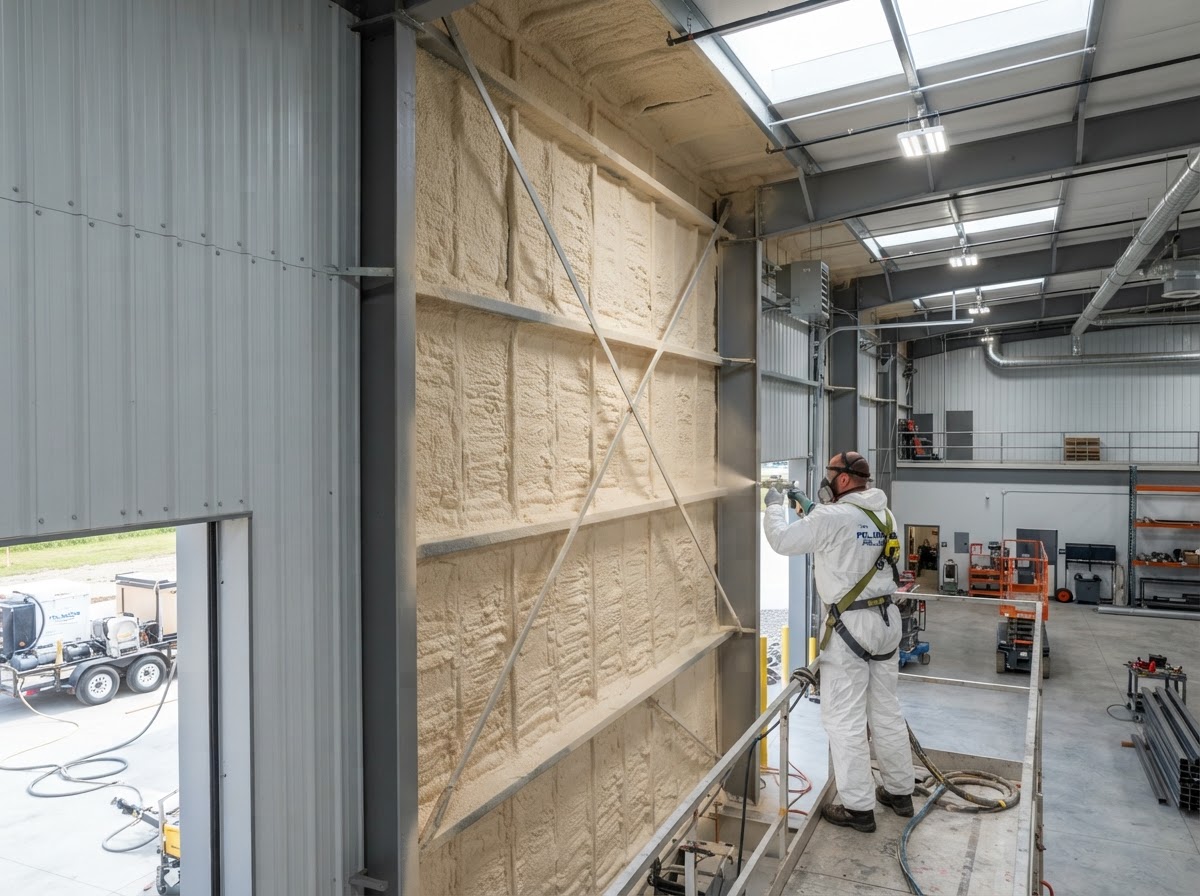
Foam across a large warehouse envelope manages condensation at scale.
Where Warehouse Foam Is Used
A warehouse has large, defined envelope surfaces. These are the applications most often evaluated for Murfreesboro facilities.
Warehouse Metal Roofs
Foam on a large metal warehouse roof addresses the condensation that forms across the expansive steel roof assembly.
Warehouse Metal Walls
Wall foam adheres to metal panels and girts across the building, sealing the envelope of the large structure.
Large Open Spaces
Big open interiors are addressed as a full envelope, with scope set by whether the space is conditioned and how it is used.
Distribution / Storage Buildings
Distribution and storage buildings use foam to protect goods and moderate conditions, with condensation a common driver.
Existing Warehouses
Existing warehouses can often be insulated, with substrate condition and access reviewed before application.
New Warehouse Construction
New warehouse construction plans foam into the metal roof and wall assemblies before finishes, coordinated with the build.
Foam Type & Warehouse Considerations
For metal-clad warehouses, closed-cell foam is commonly considered because it adheres directly to steel panels and tolerates the moisture that collects on large metal surfaces at commercial scale. For any wood-framed portions, open-cell or closed-cell may be considered based on cavity depth and use. The construction and the building's use drive the choice.
Operational planning is a key part of a warehouse project. Large commercial buildings are often in operation, and we do not imply the business can work around all active operations without any interruption. Scheduling, access, and how the work fits the building's use are part of the conversation from the start.
| Consideration | Open-Cell Foam | Closed-Cell Foam |
|---|---|---|
| Metal Roof / Walls | Generally not first choice | Direct adhesion to steel panels |
| Large Open Space | Partial as needed | Full envelope if conditioned |
| Conditioned Area | Work or storage section | Work or storage section |
| Operations | Scheduled around use | Scheduled around use |
| Selection Driver | Wood framing, depth | Metal surfaces, use, scale |
General warehouse considerations; foam depends on construction, use, and operational planning.
Planned Around Operations
We do not imply the business can work around all active operations without any interruption. Large warehouses are often in use, so scheduling, access, and how the work fits the building's operation are part of the conversation from the start.
Planning a Warehouse Project in Murfreesboro
Warehouses and distribution buildings are part of Murfreesboro and Middle Tennessee's commercial landscape, and their large metal envelopes are a frequent spray foam target. The conversation starts with the building's construction and how it is used. Murfreesboro Spray Foam Installation then reviews the metal roof and wall assemblies and outlines a foam approach, with scheduling planned around operations.
The evaluation reviews whether the warehouse is metal-clad, whether it is existing or new, and how the work fits the building's operation. From there we outline a roof, wall, or full-envelope foam approach suited to the large commercial structure.
Discuss the warehouse—metal-clad construction, existing or new—and how it is used.
Review the metal roof and wall assemblies and whether the space is conditioned.
Plan scheduling and access around the building's operations.
Recommend a roof, wall, or full-envelope foam approach suited to the facility.
Part of Commercial Spray Foam Insulation
Related Spray Foam Services
Warehouse Spray Foam FAQs
Yes. Existing warehouses can often be insulated, with substrate condition and access reviewed before application. The metal roof and wall assemblies are evaluated, and the project is planned around operations.
Ready to Insulate a Warehouse in Murfreesboro?
Tell us about your warehouse—its construction and how it is used. We review the metal roof and wall assemblies and outline an appropriate spray foam approach, with scheduling planned around operations.