Crawl Space Spray Foam Insulation in Murfreesboro, TN
Crawl space spray foam insulation addresses one of the leakiest and most moisture-sensitive areas of a Murfreesboro home. By sealing rim joists, band joists, and crawl space perimeter walls, spray foam helps limit the humid air contact with subfloor framing that is so common across Rutherford County. Murfreesboro Spray Foam Installation evaluates each crawl space individually—because spray foam is part of a moisture strategy, not a substitute for resolving groundwater, drainage, or bulk-water problems that must be handled separately.
Tell Us About Your Project
Share your building type and the areas you want insulated. We respond with project guidance.
Spray Foam Below the Home in Murfreesboro
A crawl space is one of the most challenging areas of a home because it sits below the living floor, against the ground, and is exposed to Middle Tennessee's humid air. Vented crawl spaces pull in warm, moist outdoor air that can condense against cool subfloors, ductwork, and framing. Spray foam helps by sealing the perimeter—rim joists, band joists, and stem walls—so that humid air has a harder time reaching the wood and mechanical components above.
Homeowners in Murfreesboro typically consider crawl space spray foam to address cold floors in winter, musty odors, drafty rooms above the crawl space, or as part of a broader encapsulation approach. The right strategy depends on whether the crawl space is vented or enclosed, its moisture condition, and what's in it—ductwork, plumbing, and access all matter.
Importantly, spray foam does not solve groundwater, drainage, or bulk-water problems on its own. Standing water, poor drainage, or foundation moisture must be addressed before or alongside insulation. We evaluate the crawl space condition and recommend an insulation approach that fits what we find.
Spray foam is commonly installed on crawl space rim joists, band joists, and perimeter stem walls, and sometimes beneath the subfloor. The appropriate locations depend on whether the crawl space is vented or enclosed, its moisture condition, and the overall encapsulation strategy.
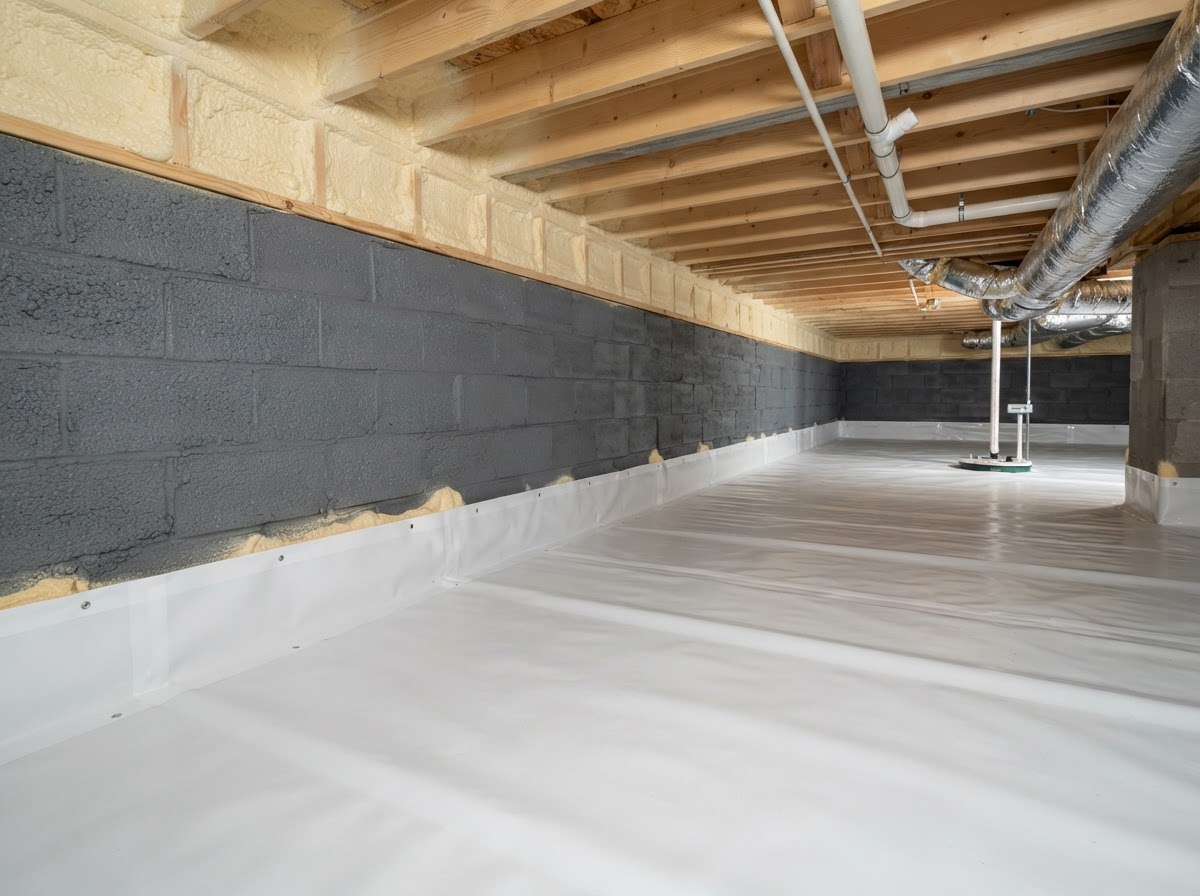
Sealing the crawl space perimeter limits humid air contact with subfloor framing.
Crawl Space Applications Near Murfreesboro
Crawl spaces vary by age, construction, and moisture condition. These are the areas and considerations we evaluate for homes across Murfreesboro and Rutherford County.
Rim & Band Joists
The perimeter framing where the floor meets the foundation is a major leakage point; sealing it limits the stack effect that pulls crawl-space air into the home.
Crawl Space Stem Walls
Insulating the perimeter masonry or framed walls helps change how the crawl space interacts with outdoor humidity, as part of an enclosure strategy.
Subfloor Underside
Where appropriate, foam beneath the subfloor adds a thermal and air layer between the crawl space and the living floor above.
Vented vs. Enclosed Strategy
Whether the crawl space stays vented or is enclosed affects where foam goes and how the assembly is designed—each is evaluated on its own.
Plumbing & Mechanical Access
Ductwork, plumbing, and access hatches are reviewed so that insulation does not interfere with maintenance or mechanical performance.
Existing Insulation Review
Existing fiberglass or batts in the crawl space are inspected; moisture-affected or fallen insulation may need to be removed before a new approach.
Foam Selection and the Moisture Question
Closed-cell foam is the most common choice for crawl spaces because of its moisture tolerance at specified thicknesses and its density on masonry and wood substrates. Open-cell, being vapor-open, is generally not the first choice for a moisture-exposed crawl space perimeter. The decision still depends on the specific assembly, the crawl space condition, and the overall encapsulation strategy.
The most important qualification: spray foam is part of a moisture-control strategy, not a replacement for resolving bulk water. Groundwater, drainage, and foundation moisture must be addressed separately. We evaluate the crawl space before recommending any foam and will flag moisture conditions that need to be handled first.
| Consideration | Open-Cell Foam | Closed-Cell Foam |
|---|---|---|
| Common Choice | Usually not first choice for crawl spaces | Commonly chosen for perimeter & rim joists |
| Moisture Behavior | Vapor-open, not moisture-resistant | Moisture-tolerant at specified thickness |
| Substrate Fit | Interior framing only | Masonry, wood rim joists, subfloor |
| Air Sealing | Seals air pathways in framing | Seals perimeter air leakage effectively |
| Encapsulation Role | Limited role in vented crawl spaces | Often part of an enclosure strategy |
| Selection Driver | Assembly design only | Moisture tolerance, substrate, enclosure |
General crawl-space considerations; actual selection depends on the evaluated crawl space condition, moisture status, and encapsulation strategy.
Spray Foam Does Not Fix Water Problems
Spray foam helps manage humid air contact with framing, but it does not resolve groundwater, drainage, or bulk-water issues. Standing water, poor grading, or foundation moisture must be addressed before or alongside insulation. We evaluate the crawl space and flag moisture conditions that need separate handling.
Crawl Space Projects in Rutherford County
Murfreesboro and the surrounding Rutherford County have a wide range of crawl space conditions—older vented spaces with settled fiberglass, newer enclosed foundations, and everything in between. Middle Tennessee's humidity makes the crawl space a priority area for air and moisture strategy, but only after any bulk-water issues are identified and addressed.
A crawl space project starts with understanding the home's age, the crawl space condition, and what's down there—ductwork, plumbing, and access. From there we evaluate moisture status, review the assembly, and recommend whether rim-joist, stem-wall, or subfloor sealing fits, and which foam is appropriate.
Discuss the home's age, crawl space type, and any known moisture or odor concerns.
Review the crawl space condition—moisture, existing insulation, ductwork, plumbing, and access.
Flag any bulk-water or drainage issues that must be handled before insulation.
Recommend an appropriate foam approach for the rim joists, stem walls, or subfloor.
Crawl Space Spray Foam FAQs
Yes, where appropriate. Foam can be applied beneath the subfloor to add a thermal and air layer between the crawl space and the living floor above. Whether that is the right location depends on the crawl space type, moisture condition, and overall strategy.
Concerned About Your Murfreesboro Crawl Space?
Tell us about your home's crawl space type and any moisture or comfort concerns. We evaluate the condition, flag any water issues, and outline an appropriate crawl-space spray foam approach.