
Attic Spray Foam Insulation in Murfreesboro, TN
Attic spray foam insulation is one of the most requested applications for Murfreesboro homeowners, and for good reason. By applying polyurethane foam to the underside of the roof deck, the thermal boundary moves from the attic floor up to the roofline, bringing HVAC equipment and ductwork inside a conditioned zone. Murfreesboro Spray Foam Installation handles attic roof decks, attic floor sealing, and retrofit attic upgrades across Murfreesboro and Middle Tennessee, evaluating each roof assembly before recommending open-cell or closed-cell foam.
Tell Us About Your Project
Share your building type and the areas you want insulated. We respond with project guidance.
How Attic Spray Foam Changes the Building Envelope
A traditional vented attic sits outside the home's thermal envelope, so the attic temperature swings with the outdoor air. In Middle Tennessee summers, that means attic air can climb well above the outdoor temperature, and any HVAC ductwork running through that space works against a harsh environment. Spray foam applied to the underside of the roof deck changes that boundary, moving the insulation line to the roofline so the attic sits closer to the conditioned interior.
Homeowners in Murfreesboro usually come to attic spray foam trying to address hot upper rooms, an HVAC system working hard, or a planned renovation where the roof framing is exposed. The right approach depends on the roof assembly—whether the attic is vented or unvented, the rafter depth, and whether the goal is a conditioned attic or sealing the attic floor instead.
Not every attic is a candidate for a roof-deck application, and a roof-deck approach is not the only option. Sealing the attic floor, insulating a knee-wall, or addressing a specific leakage path may be more appropriate for some homes. We evaluate the roof and the home's overall envelope before recommending where the foam should go.
Yes. Spray foam can be installed in an attic, most commonly along the underside of the roof deck or across the attic floor. Whether a roof-deck or floor approach is appropriate depends on the roof assembly, ventilation design, and whether the goal is a conditioned attic.
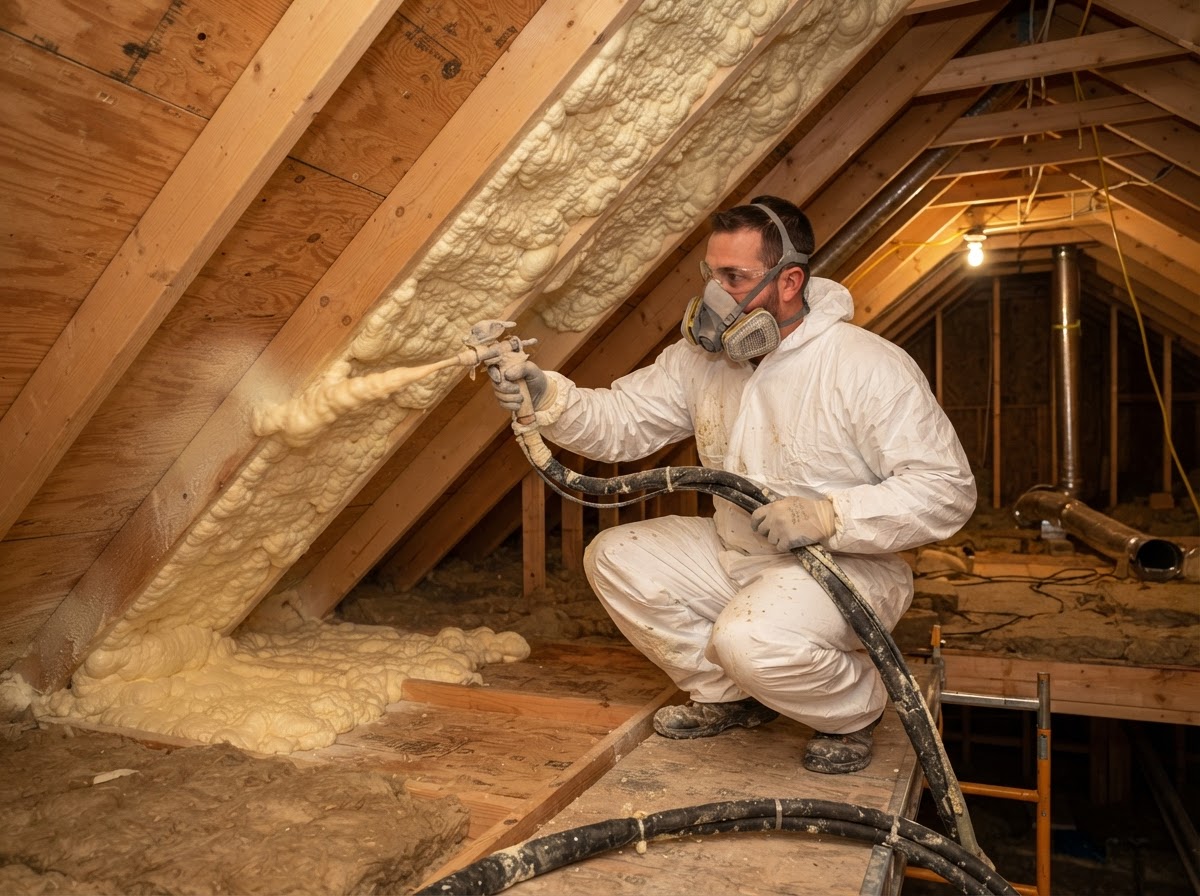
Roof-deck foam moves the thermal boundary to the roofline.
Attic Applications for Murfreesboro Homes
Attics are not all the same. These are the specific attic applications and considerations we evaluate for homes across Murfreesboro and Rutherford County.
Roof Deck Insulation
Foam along the underside of the roof deck moves the thermal line to the rafters, bringing attic ductwork and equipment inside the conditioned boundary.
Unvented Attic Assemblies
Where the roof design supports it, a sealed attic assembly changes how the attic interacts with the home, evaluated against the specific roof construction.
Attic Floor Sealing
When a roof-deck approach is not appropriate, sealing the attic floor and addressing bypasses can still improve the boundary between attic and living space.
HVAC Ductwork Considerations
Ductwork located in the attic is a common driver for roof-deck foam, since bringing ducts inside a conditioned zone changes the load on the system.
Existing Insulation Review
Existing insulation condition—settled, displaced, or moisture-affected—affects whether removal or a new layer is appropriate before applying foam.
Attic Access & Leakage
Pull-down stairs, scuttles, and dropped soffits are major leakage points; addressing access is part of an attic air-sealing approach.
Roof Deck or Attic Floor — and Which Foam
The first decision in an attic project is where the foam goes. A roof-deck application creates a conditioned attic but requires a roof assembly that supports an unvented design. An attic-floor approach keeps the attic outside the envelope and focuses on sealing the boundary between attic and living space. The roof construction, ventilation, and the home's overall design determine which is appropriate.
If a roof-deck approach is selected, foam type matters. Open-cell is frequently considered for roof decks where the rafter depth is generous and a vapor-open assembly is appropriate; closed-cell may be considered where moisture strategy or limited rafter depth calls for a denser material. These decisions are made per assembly.
| Consideration | Open-Cell Foam | Closed-Cell Foam |
|---|---|---|
| Thermal Boundary | Often roof deck, conditioned attic | Roof deck or floor, denser layer |
| Expansion | Fills deep rafter bays well | Controlled lifts, less expansion |
| Moisture Strategy | Vapor-open roof assembly | Moisture-tolerant at specified thickness |
| Space Consideration | Needs generous rafter depth | Fits shallower rafter cavities |
| Air Sealing | Continuous barrier across rafters | Continuous barrier at lower thickness |
| Selection Driver | Roof design, depth, cost goals | Moisture, limited depth, assembly |
General attic considerations; the appropriate location and foam depend on the evaluated roof assembly, ventilation, and project goals.
Does Roof-Deck Foam Make an Attic Conditioned?
Applying foam to the roof deck can move the attic inside the thermal envelope, but whether the attic is truly conditioned depends on the full assembly—ventilation design, mechanical supply, and the roof construction. We evaluate the roof before recommending a roof-deck approach.
Attic Projects in Murfreesboro's Climate
Murfreesboro's hot, humid summers put real stress on vented attics. Roof-deck foam is one way homeowners address that stress, but the approach has to match the roof assembly—not every roof supports an unvented design. Existing insulation, ductwork location, and attic access all factor into the recommendation.
An attic project starts with understanding the home's age, the roof construction, and whether ductwork or equipment sits in the attic. From there we review the assembly and outline whether a roof-deck or attic-floor approach is appropriate, and which foam fits that location.
Discuss the home's roof type, attic use, and whether HVAC equipment or ductwork is located in the attic.
Review the roof assembly—rafter depth, ventilation design, and existing insulation condition.
Determine whether a roof-deck or attic-floor approach fits, and whether open-cell or closed-cell is appropriate.
Address existing insulation and access points, apply the foam, and review coverage.
Attic Spray Foam FAQs
It depends on the roof assembly. A roof-deck application moves the thermal boundary to the roofline and can bring ductwork inside a conditioned zone, but only when the roof design supports it. An attic-floor approach keeps the attic outside the envelope and focuses on sealing the boundary. We evaluate the roof before recommending either.
Ready to Address Your Murfreesboro Attic?
Tell us about your home's roof type, the attic, and whether HVAC equipment runs through it. We review the roof assembly and outline an appropriate attic spray foam approach.