
Open Cell Spray Foam Insulation in Murfreesboro, TN
Open-cell spray foam is a lighter, highly expanding polyurethane insulation used inside residential and commercial framing throughout Murfreesboro and Middle Tennessee. Its rapid expansion helps it fill deep wall cavities, roof rafter bays, and irregular framing gaps, creating an air-sealing layer in a single application. Murfreesboro Spray Foam Installation applies open-cell foam where the building assembly and design call for a vapor-open, high-expansion approach—often in interior roof decks and wall cavities of new construction and remodels.
Tell Us About Your Project
Share your building type and the areas you want insulated. We respond with project guidance.
What Open-Cell Spray Foam Does in a Building
Open-cell spray polyurethane foam gets its name from its cellular structure: the cells formed during the reaction do not fully close, leaving a softer, lighter, more flexible material. That open structure is what gives the foam its high expansion rate—when sprayed, it grows to fill a larger volume than closed-cell foam, conforming around framing, wiring, and irregular geometry.
Customers in Murfreesboro typically consider open-cell foam for interior applications where expansion is an advantage and where a vapor-open assembly is acceptable—deep wall cavities, roof rafter bays, and interior partitions. Because it stays flexible after curing, it can accommodate the natural movement of wood framing without cracking or pulling away from the substrate.
Open-cell foam is not automatically the right choice for every location. Where moisture exposure, limited cavity depth, or a vapor-retarding assembly is the priority, a different approach may be more appropriate. The building assembly determines where open-cell fits.
Open-cell spray foam is a polyurethane insulation with a soft, open cellular structure that expands rapidly on application to fill cavities and seal air pathways. Its lighter density and high expansion make it well suited to interior framing and roof decks where a vapor-open assembly is appropriate.
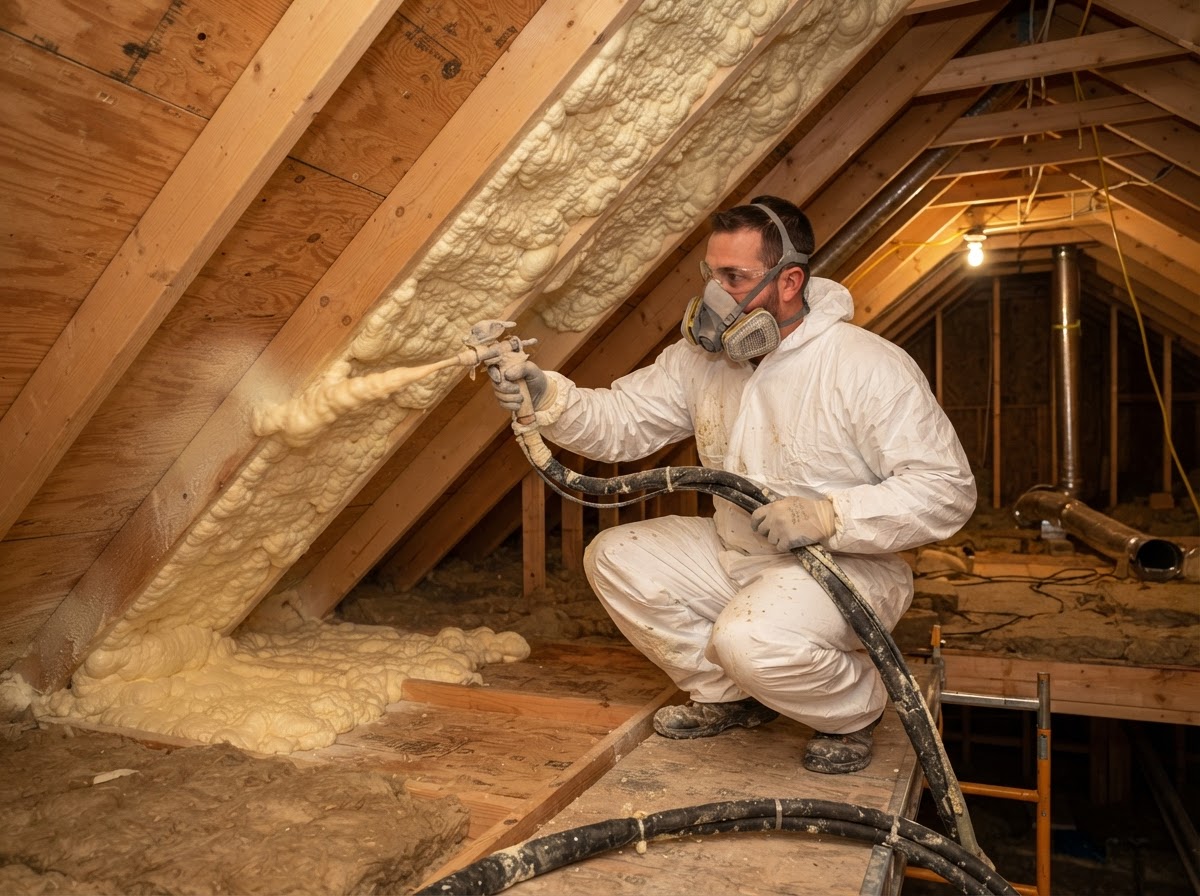
Open-cell foam's high expansion fills deep rafter bays in a single pass.
Where Open-Cell Foam Is Commonly Applied
Open-cell foam is most often used inside the conditioned envelope of a building. These are the applications where its expansion and flexibility are an advantage across Murfreesboro homes and light commercial projects.
Interior Roof Decks
Applied to the underside of rafters, open-cell foam fills deep rafter bays and helps bring the attic inside the conditioned envelope where the roof assembly allows it.
Exterior Wall Cavities
In new construction and open remodels, the foam expands to fill 2x4 and 2x6 stud bays, sealing around wiring, outlets, and top plates.
Interior Partitions
Open-cell's softer structure offers some acoustic dampening between rooms, which is one reason it is used in interior wall assemblies.
Floor & Ceiling Assemblies
Between floors or beneath bonus rooms, open-cell foam can reduce air transfer and add a degree of sound dampening within the building.
Cathedral & Vaulted Ceilings
Deep, enclosed rafter bays in cathedral ceilings are a common fit for open-cell where the assembly design supports a vapor-open approach.
New Construction Framing
With framing exposed before drywall, open-cell foam can be applied across walls and rooflines to establish the interior envelope in one coordinated step.
Open-Cell vs. Closed-Cell: How They Differ
Open-cell and closed-cell foam are both polyurethane insulations, but they behave differently because of their cellular structure. Open-cell is lighter, expands more, and stays vapor-open; closed-cell is denser, expands less, and resists moisture at specified thicknesses. Neither is universally better—the correct choice depends on where in the building the foam is going and how that assembly is designed.
Open-cell is generally selected where deep cavities benefit from expansion, where flexibility is valued, and where a vapor-open assembly is appropriate. Closed-cell is typically chosen where moisture resistance, limited depth, or a denser layer is the priority. Comparing them side by side helps clarify which fits a specific Murfreesboro project.
| Consideration | Open-Cell Foam | Closed-Cell Foam |
|---|---|---|
| Density / Structure | Lighter, open, soft cells | Dense, sealed, rigid cells |
| Expansion | High expansion fills deep cavities | Lower, controlled expansion |
| Typical Application | Interior walls, roof decks, partitions | Crawl spaces, metal, tight cavities |
| Air Sealing | Effective air barrier when installed well | Effective air barrier at lower thickness |
| Moisture Behavior | Vapor-open, does not resist moisture | Moisture-resistant at specified thickness |
| Space / Thickness | Needs generous cavity depth | Fits shallower, restricted cavities |
General comparison only; the appropriate foam depends on the evaluated building assembly, location, and project specifications.
Choosing the Right Foam Type
The correct foam depends on the building assembly, the location within the building, moisture strategy, and cavity depth—not on a universal preference. We evaluate each area before recommending open-cell, closed-cell, or a combination across different parts of the same project.
Using Open-Cell Foam on Murfreesboro Projects
Across Murfreesboro and Rutherford County, open-cell foam shows up most often in new construction and remodels where interior framing and roof decks are exposed. Middle Tennessee's humid climate means roof-assembly design matters—whether an attic is vented or unvented affects whether an open-cell roof deck application is appropriate for that specific home.
An open-cell project typically starts with understanding the building type, the areas being considered, and whether the roof or wall assembly supports a vapor-open approach. From there we can outline where open-cell fits and where a different foam might be better suited.
Discuss the building type and whether the areas are interior framing, roof decks, or partitions.
Review the assembly—rafter depth, wall cavity size, and whether a vapor-open approach is appropriate.
Confirm where open-cell fits and where closed-cell may be needed in the same building.
Apply the foam and review coverage across the open framing.
Open-Cell Spray Foam FAQs
Open-cell spray foam is a polyurethane insulation with a soft, open cellular structure. Its lighter density and high expansion allow it to fill deep cavities and seal air pathways. It is typically used inside the conditioned envelope where a vapor-open assembly is appropriate.
Considering Open-Cell Foam for Your Project?
Share your building type and the areas you are considering for insulation. We review whether an open-cell approach fits the assembly and outline the appropriate foam for each part of the project.