
Closed Cell Spray Foam Insulation in Murfreesboro, TN
Closed-cell spray foam is a dense polyurethane insulation used across Murfreesboro and Middle Tennessee where moisture resistance, a compact profile, or a rigid layer is the priority. Its sealed cellular structure resists moisture at specified thicknesses and delivers a high thermal resistance per inch, which makes it a common choice for crawl spaces, metal buildings, rim joists, and tight cavities. Murfreesboro Spray Foam Installation applies closed-cell foam where the building assembly calls for that denser, more moisture-tolerant approach.
Tell Us About Your Project
Share your building type and the areas you want insulated. We respond with project guidance.
What Makes Closed-Cell Foam Different
Closed-cell spray polyurethane foam is defined by its cellular structure: during the reaction, the cells close and seal, trapping a blowing agent and creating a dense, rigid material. That sealed structure is what gives closed-cell foam its moisture resistance at specified thicknesses and its higher thermal resistance per inch compared with open-cell foam. It expands less than open-cell, so application is done in controlled lifts.
Customers in Murfreesboro typically consider closed-cell foam for locations where a denser, more moisture-tolerant material is wanted—crawl space walls and rim joists, the interior of metal buildings, and framing cavities with limited depth. Because it is rigid, it can also add some structural rigidity to an assembly, though that benefit is qualified by the specific application.
Closed-cell is not automatically the best choice everywhere. In deep interior cavities or vapor-open roof assemblies, open-cell may be more appropriate. The building assembly, moisture exposure, and available cavity depth drive the decision—not a preference for one product over the other.
Closed-cell spray foam is a dense polyurethane insulation with sealed cells that resist moisture at specified thicknesses and provide high thermal resistance per inch. Its rigid structure and compact profile make it a common choice for crawl spaces, metal buildings, and shallow cavities.
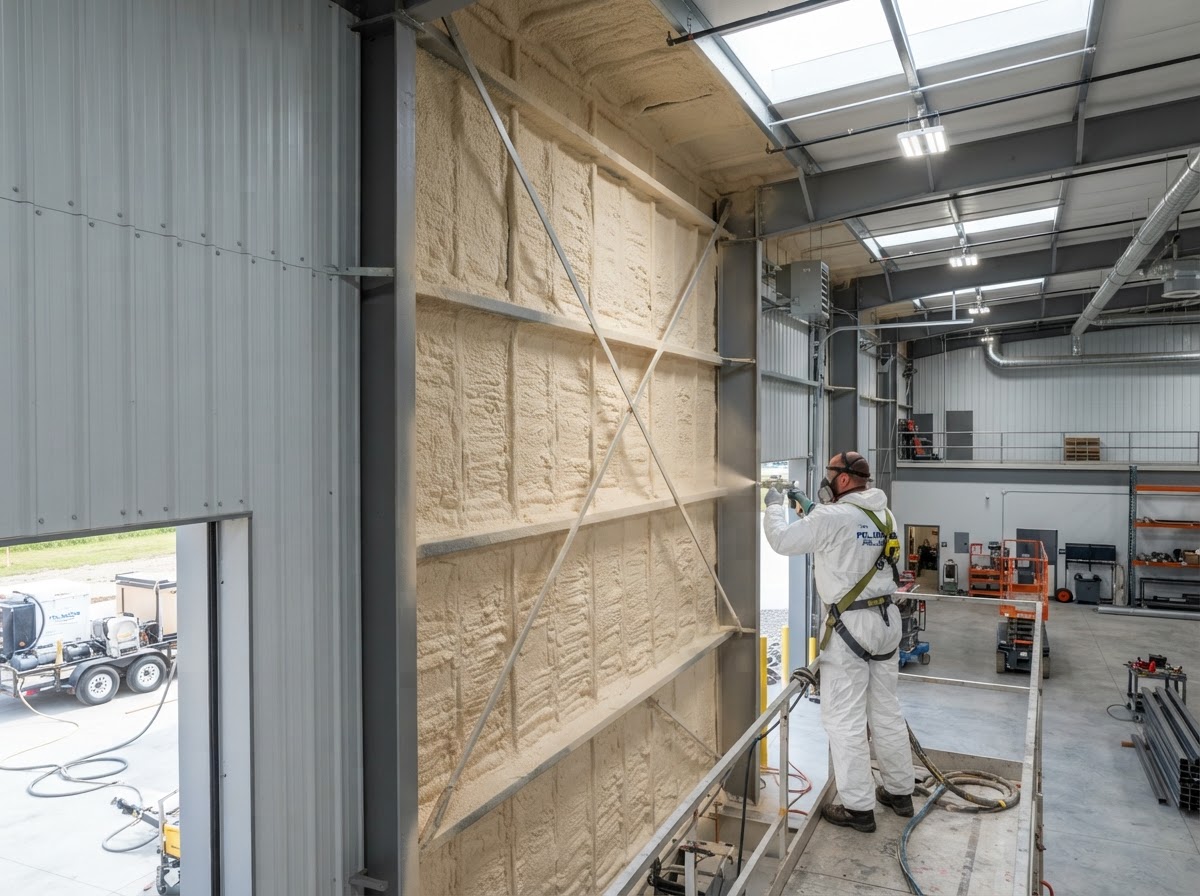
Closed-cell foam adheres directly to metal, helping isolate interior air from cold steel surfaces.
Where Closed-Cell Foam Fits Near Murfreesboro
Closed-cell foam is selected for the assemblies where density, moisture tolerance, or a compact profile matters most. These are the applications where it is commonly considered.
Crawl Space Walls & Rim Joists
Closed-cell is frequently chosen for crawl space perimeters and rim joists where moisture exposure and limited cavity depth make a dense, moisture-tolerant material appropriate.
Metal Building Interiors
Applied directly to corrugated steel panels and purlins, closed-cell foam adheres to metal and helps isolate interior air from cold surfaces in steel structures.
Pole Barns & Post-Frame
Where post-frame buildings are used for conditioned or semi-conditioned space, closed-cell is often considered for roof and wall assemblies on metal and wood substrates.
Garage Walls & Ceilings
Tight garage framing and ceilings benefit from a denser layer where cavity depth is limited and a moisture-tolerant material is wanted.
Workshop Rooflines
Workshops with metal or limited-depth framing often use closed-cell on roof and wall assemblies to support a more controlled interior environment.
Limited-Depth Cavities
Where framing depth is shallow and a denser layer is needed, closed-cell delivers higher thermal resistance per inch than open-cell in the same space.
Closed-Cell vs. Open-Cell: Key Distinctions
The difference between closed-cell and open-cell foam comes down to cellular structure and the properties that follow from it. Closed-cell is denser, resists moisture at specified thicknesses, and needs less depth to achieve a given thermal layer. Open-cell is lighter, expands more, and stays vapor-open. Each fits different parts of a building.
Closed-cell is typically chosen where moisture exposure, metal substrates, or limited cavity depth make a denser material appropriate. Open-cell is usually selected for deep interior cavities and roof decks where expansion and a vapor-open assembly are preferred. Both can appear in the same building, applied to different assemblies based on what each area needs.
| Consideration | Open-Cell Foam | Closed-Cell Foam |
|---|---|---|
| Density / Structure | Lighter, open, soft cells | Dense, sealed, rigid cells |
| Moisture Resistance | Vapor-open, not moisture-resistant | Resists moisture at specified thickness |
| Per-Inch Performance | Lower per inch, fills more volume | Higher thermal resistance per inch |
| Typical Location | Interior walls, roof decks, partitions | Crawl spaces, metal, rim joists |
| Substrate Fit | Wood framing, interior assemblies | Metal, masonry, limited-depth framing |
| Selection Driver | Depth, expansion, vapor-open design | Moisture, metal, limited depth |
General distinctions; selection depends on the evaluated assembly, moisture strategy, and cavity depth—not on a universal rule.
Is Closed-Cell Always the Best Choice?
No. Closed-cell foam is the right choice where moisture exposure, metal substrates, or limited cavity depth make a denser material appropriate. In deep interior cavities or vapor-open roof assemblies, open-cell may be a better fit. The correct application is determined by the specific building assembly, not assumed.
Closed-Cell Foam in Murfreesboro Building Conditions
Middle Tennessee's humidity makes moisture strategy a real consideration in crawl spaces, metal buildings, and rim-joist assemblies. Closed-cell foam is often part of that strategy because of its moisture tolerance at specified thicknesses, but it does not replace the need to address groundwater, drainage, or bulk-water issues that must be handled separately.
Across Murfreesboro and Rutherford County, closed-cell foam is common in crawl space retrofits, metal shop and storage buildings, and new construction rim-joist sealing. A project starts with understanding the structure, the areas being considered, and whether a denser, moisture-tolerant layer is appropriate for that assembly.
Discuss the building type and which areas are exposed to moisture or have limited cavity depth.
Review the assembly—crawl space perimeter, metal panels, or rim joists—and note substrate condition.
Confirm whether closed-cell is appropriate for the area or whether open-cell fits better elsewhere.
Apply in controlled lifts and review the finished coverage.
Closed-Cell Spray Foam FAQs
Closed-cell foam has sealed, dense, rigid cells that resist moisture at specified thicknesses and provide higher thermal resistance per inch. Open-cell has open, lighter, softer cells that expand more and stay vapor-open. They suit different assemblies—closed-cell for moisture-exposed or limited-depth areas, open-cell for deep interior cavities.
Considering Closed-Cell Foam for Your Murfreesboro Project?
Tell us about the building type and the areas you want insulated—especially crawl spaces, metal buildings, or tight cavities. We review the assembly and outline whether a closed-cell approach fits the project.