
Residential Spray Foam Insulation in Murfreesboro, TN
Murfreesboro Spray Foam Installation provides residential spray polyurethane foam insulation for homes across Murfreesboro and surrounding Middle Tennessee communities. From existing houses dealing with drafty rooms and uneven temperatures to newly framed custom homes, we insulate attics, crawl spaces, exterior wall cavities, rim joists, garages, and additions. Open-cell and closed-cell spray foam options let us match the right product to each building assembly, creating a continuous air-sealing layer and thermal boundary engineered for the regional climate.
Tell Us About Your Project
Share your building type and the areas you want insulated. We respond with project guidance.
Spray Foam Insulation for Murfreesboro Homes
Residential spray foam insulation is an expanding polyurethane material applied directly to the framing, decking, or foundation surfaces of a home. As it is sprayed, the liquid reacts and expands within seconds to fill stud bays, rafter cavities, and rim-joist gaps, adhering to wood, concrete, and metal. This expansion is what allows spray foam to seal the small cracks and penetrations that traditional fiberglass batts leave open.
Homeowners in Murfreesboro typically come to spray foam trying to address a specific concern—hot second-floor rooms, cold floors over a crawl space, drafts around outlets and trim, or a newly built home where they want a tighter envelope from the start. The right approach depends on where in the building the work is happening, how that assembly is constructed, and what the occupants are trying to improve.
Because every home is different, the application area matters as much as the product. An attic roof deck, an exterior wall cavity, and a crawl space stem wall each behave differently under Middle Tennessee's humidity and temperature swings. We evaluate the building assembly before recommending an open-cell or closed-cell approach.
Spray foam can be used in several areas of a home, including attic roof decks, exterior wall cavities where accessible, crawl space walls and rim joists, garage ceilings, and additions. The suitable location and foam type depend on the building assembly, access, and whether the space is conditioned or unconditioned.
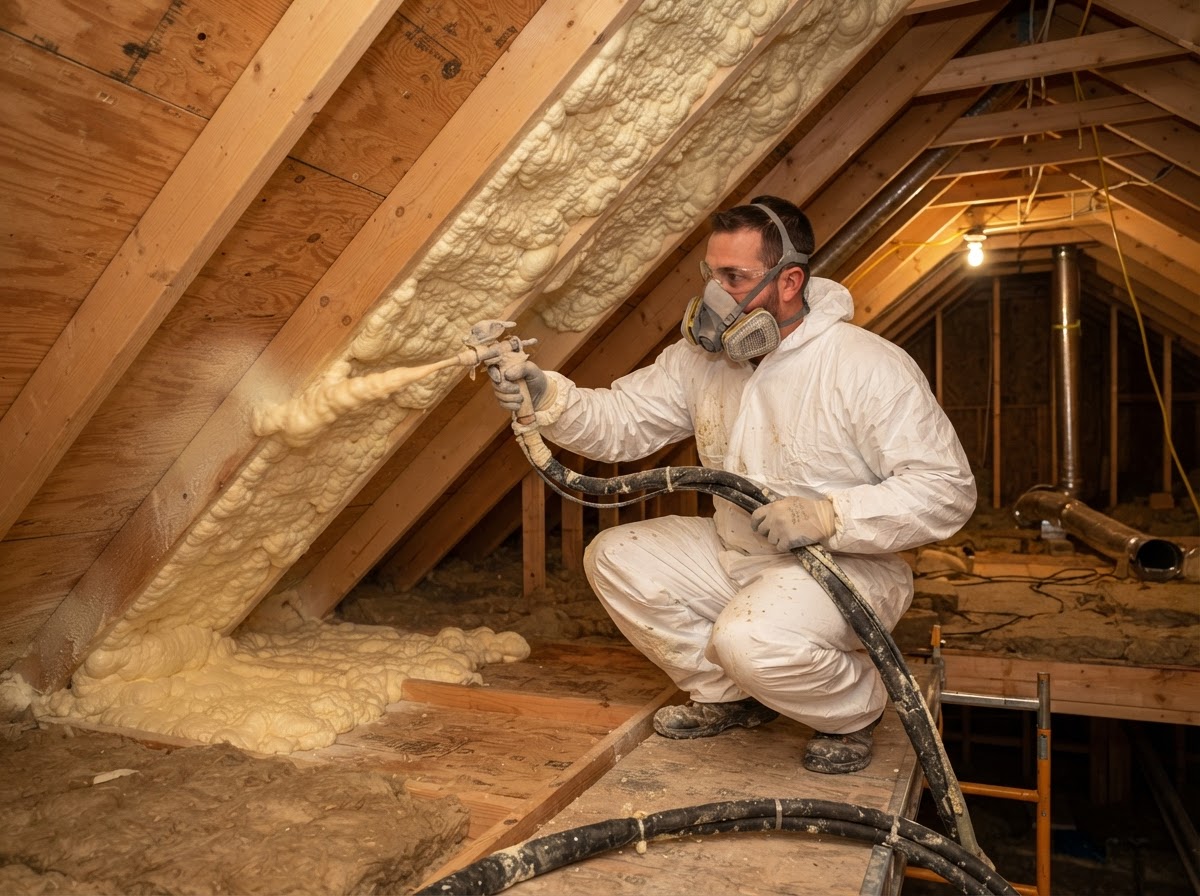
Attic roof deck insulation is one of the most common residential applications.
Common Residential Applications Near Murfreesboro
Spray foam is used across a wide range of residential building areas. These are the applications Murfreesboro homeowners most often request, each evaluated individually for the correct foam and thickness.
Attic Roof Decks
Foam applied to the underside of the roof deck moves the thermal boundary to the roofline, bringing attic HVAC equipment and ductwork inside a conditioned zone.
Exterior Wall Cavities
Open-cell or closed-cell foam fills stud bays in new construction or accessible remodels, sealing gaps around wiring, outlets, and top plates that batts miss.
Crawl Space Walls & Rim Joists
Sealing the perimeter of a crawl space and the rim joist band helps limit humid air contact with subfloor framing common in Rutherford County homes.
Garage Ceilings & Walls
Insulating the ceiling beneath a bonus room or the walls of an attached garage isolates living space from engine heat, exhaust, and temperature swings.
Additions & Remodels
When walls or ceilings are open during a renovation, spray foam can establish a clean, continuous envelope in the new or modified space.
Rim & Band Joists
The perimeter framing where the floor system meets the foundation is a major leakage point; sealing it reduces stack-effect air movement through the home.
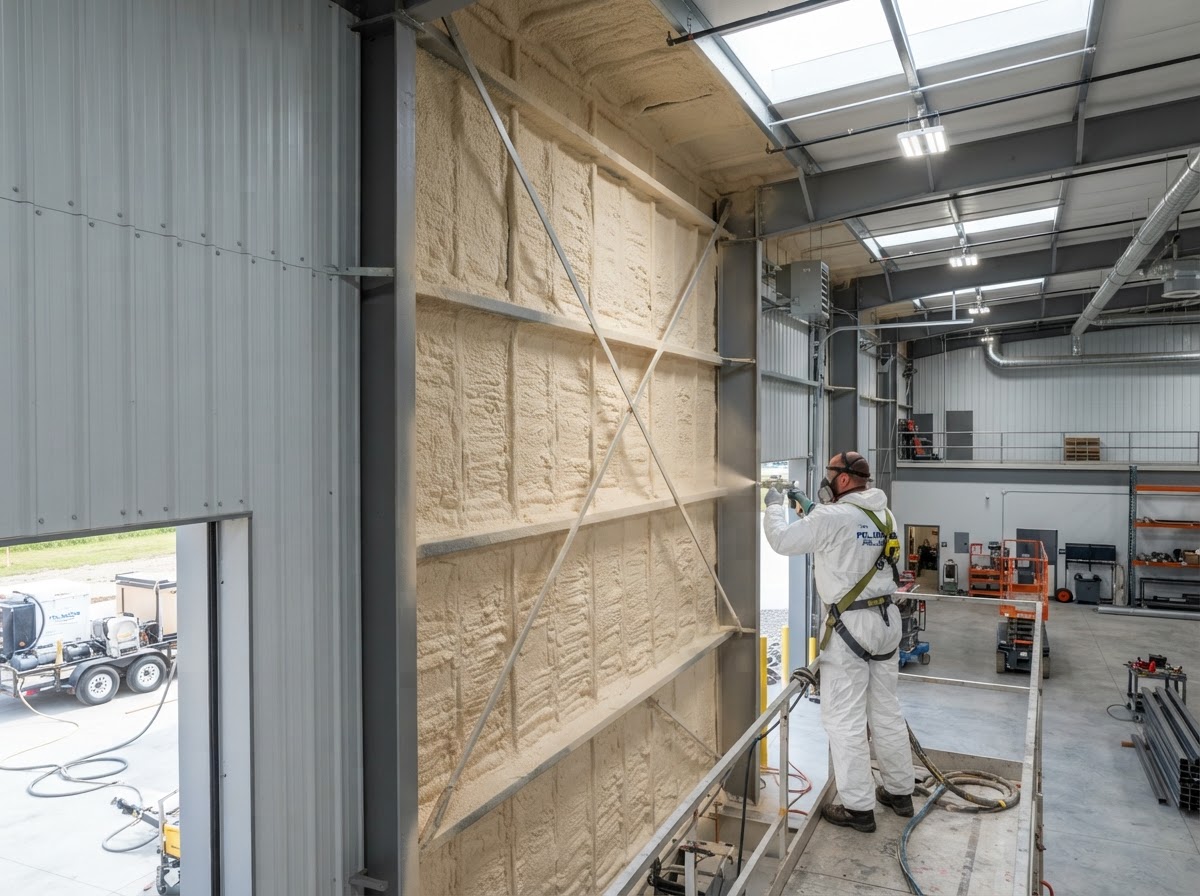
Open-Cell or Closed-Cell Foam for Your Home
There is no single correct foam for every residential project. The decision depends on the building assembly, the depth of the framing cavity, whether the area is exposed to moisture, and the performance goals for that part of the home. A roof deck with deep rafters may be approached differently than a shallow wall cavity or a damp crawl space.
Open-cell foam is frequently selected for interior roof decks and wall cavities where expansion helps fill deeper bays and where a vapor-open assembly is appropriate. Closed-cell foam is often chosen where moisture resistance matters, where cavity depth is limited, or where a denser, more rigid material is wanted. We do not assume one product is automatically correct—each area is reviewed on its own conditions.
| Consideration | Open-Cell Foam | Closed-Cell Foam |
|---|---|---|
| Structure | Soft, open, lighter cells | Dense, sealed, rigid cells |
| Expansion | Expands significantly to fill deep cavities | Lower expansion, controlled lifts |
| Typical Home Use | Interior roof decks, deep wall cavities | Crawl spaces, rim joists, tight cavities |
| Air Sealing | Effective air barrier when installed correctly | Effective air barrier at lower thickness |
| Space Consideration | Generous cavity depth helpful | Fits shallower or restricted cavities |
| Selection Driver | Assembly design, depth, cost goals | Moisture exposure, limited depth |
General residential considerations only; actual selection is based on the evaluated building assembly and project specifications.
How the Right Foam Is Determined
Foam selection depends on the specific building assembly, framing depth, moisture exposure, ventilation design, and project specifications—not on a universal rule. We review each area directly before recommending an approach.
Planning a Residential Spray Foam Project in Murfreesboro
Murfreesboro sits in a humid subtropical climate zone, which means homes here face hot, humid summers and cool, damp winters. That combination puts real stress on building envelopes—attics heat well above outdoor temperature in summer, crawl spaces pull in humid air that can condense against cool surfaces, and mixed residential development means building ages and construction styles vary widely across Rutherford County.
Whether the project is an existing home upgrade or new construction, a short conversation helps us understand the structure type, the areas being considered, and access. From there we can review the application area and outline an appropriate spray foam approach.
Discuss the home type, age, and the specific rooms or areas with comfort concerns.
Review the application areas—attic, crawl space, walls, or garage—and note access and existing insulation.
Determine an appropriate open-cell or closed-cell approach for each area based on the assembly.
Schedule and complete the application, then review the finished work together.
Related Spray Foam Services
Residential Spray Foam FAQs for Murfreesboro Homeowners
Yes. Spray foam can be incorporated into many existing homes, particularly in unfinished spaces like attics, crawl spaces, and accessible rim joists. The appropriate approach depends on access, existing insulation, the building assembly, and the area being addressed—not every finished wall can be insulated without opening it.
Ready to Improve Your Murfreesboro Home's Insulation?
Tell us about your home—the building type, the rooms or areas with concerns, and the project location. We review the application areas and outline an appropriate residential spray foam approach.